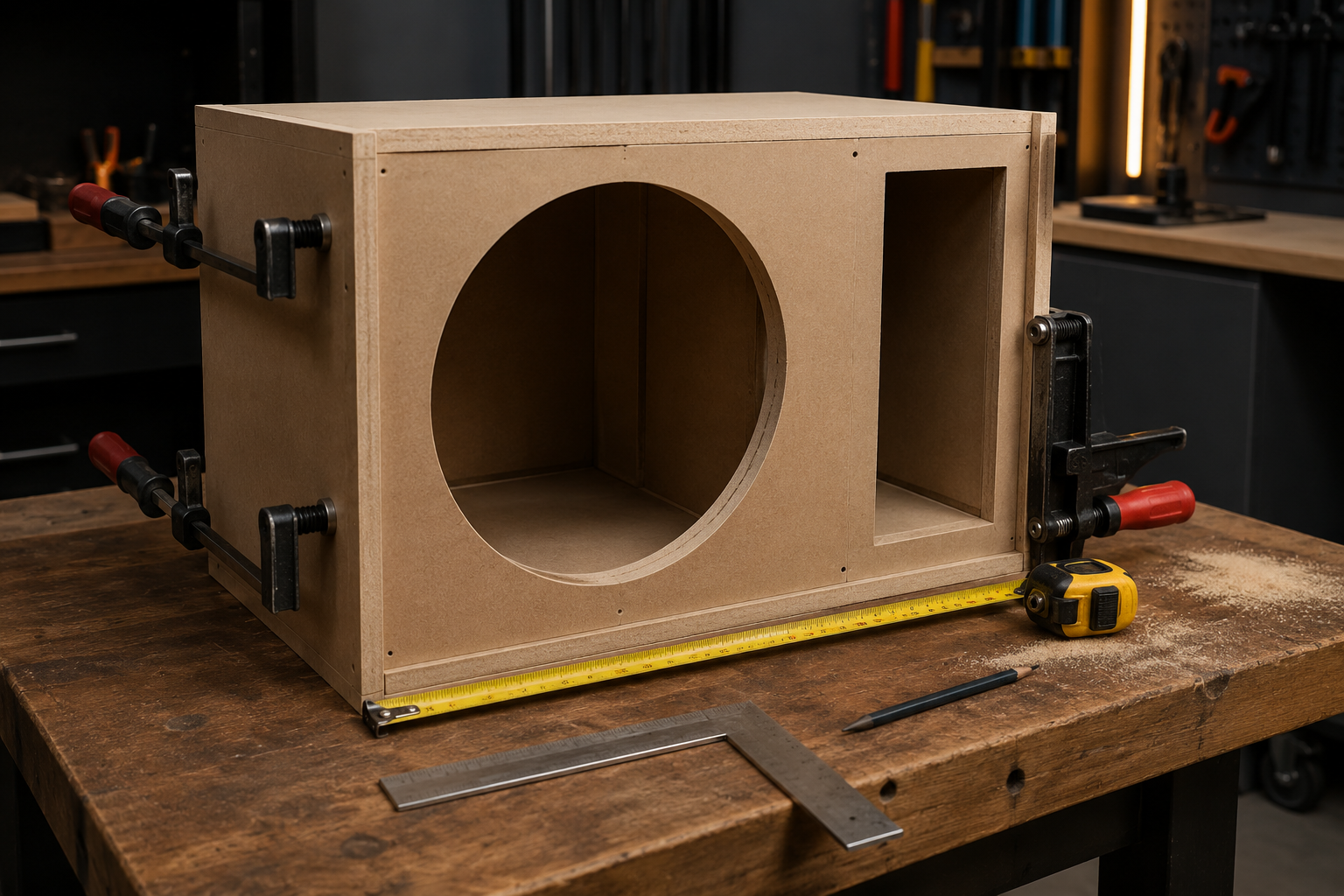
1. Separate gross volume from net volume
Gross internal volume is the air space inside the enclosure before anything is installed. Net volume is what remains after subtracting the driver, port, bracing, and any internal hardware displacement.
Manufacturer enclosure recommendations normally refer to net air space, but verify the wording in the specific driver's documentation.
2. Measure the space you actually have
- Measure the narrowest loading path as well as the final mounting location; a box that fits the trunk may not pass through its opening.
- If you start with external dimensions, subtract twice the panel thickness from each outside dimension to find the basic internal dimensions.
- Leave clearance for the subwoofer motor, pole vent, terminals, port entrance, cargo movement, and amplifier ventilation.
3. Size the port as a system
Port area, effective length, net volume, and tuning frequency interact. Increasing port area usually requires a longer port for the same tuning, and the longer port consumes more enclosure volume.
Do not copy only a tuning frequency from another build. Use the complete manufacturer design or enclosure-modeling software with the correct driver parameters, intended power, and high-pass or subsonic filtering.
4. Build and verify
- Dry-fit panels and confirm the final internal dimensions before assembly.
- Use straight, square joints, adequate bracing, and a continuous airtight seal on every non-port seam.
- Round or flare restrictive port edges when the design allows it and keep the port entrance clear of the driver and walls.
- After assembly, re-measure the finished dimensions and calculate the actual net volume before calling the design complete.