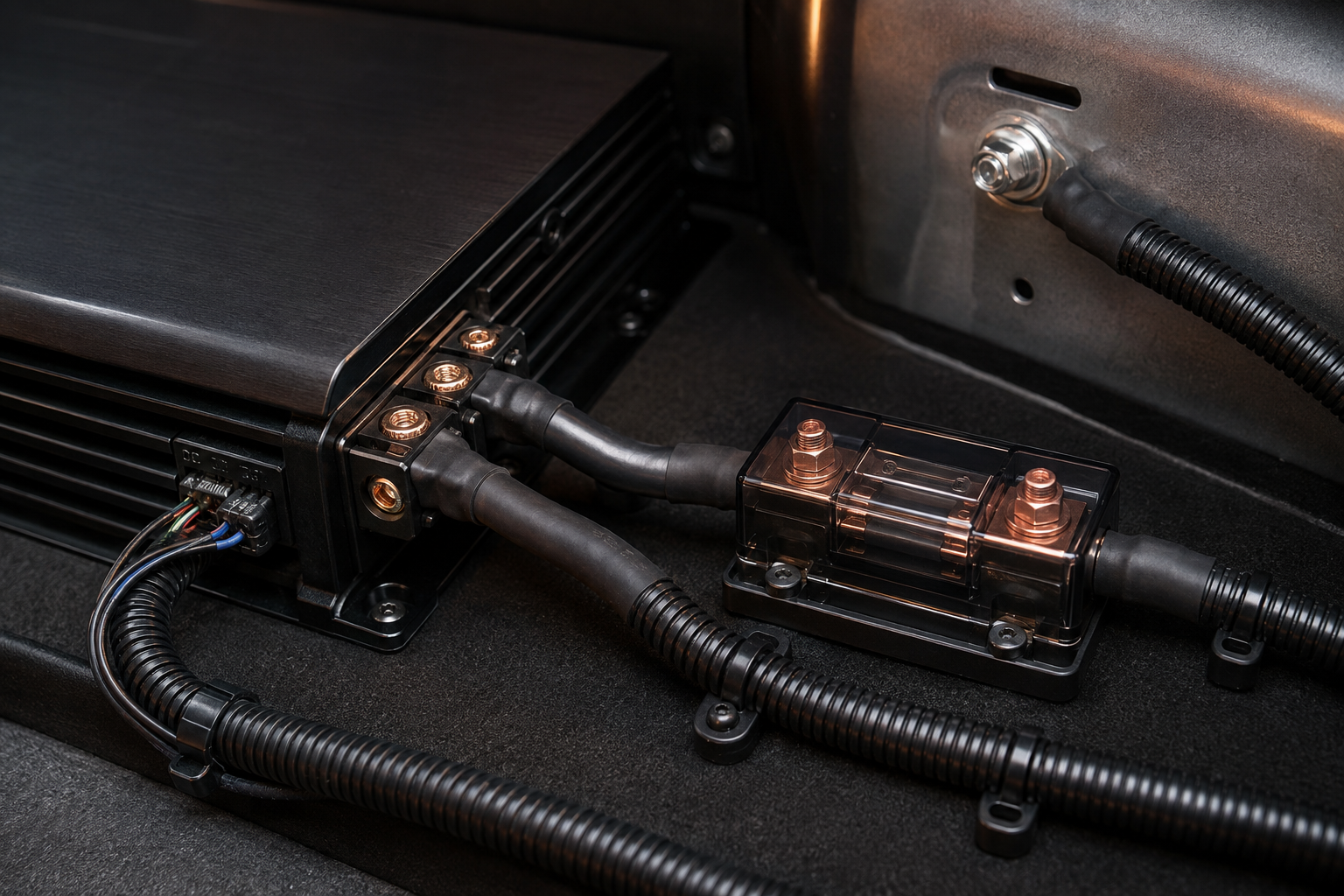
1. Calculate the target voltage
For a resistive reference load, target AC voltage is the square root of RMS power multiplied by impedance: V = √(P × R). Example: 500 watts into 2 ohms gives √1000, or about 31.6 volts AC.
A loudspeaker is not a fixed resistor across frequency. The calculation is a setup reference, not proof that the amplifier will deliver the same power into the real driver at every frequency.
2. Prepare the signal chain
- Disconnect the speakers from the amplifier outputs.
- Turn EQ, loudness, bass boost, and processing that changes level off or to their neutral positions.
- Set crossovers as required by the system plan and use a clean test tone appropriate for the channel being adjusted.
- Determine a source-unit volume that remains unclipped. If this has not been measured, use a conservative level and recognize the uncertainty.
3. Adjust and stop at the limit
- Set the meter to AC volts and connect it across the correct amplifier output terminals.
- Play the test tone and raise the gain slowly until the meter reaches the calculated target voltage.
- Stop earlier if a verified clipping indicator or the amplifier's documented limit is reached.
- Turn the system off, reconnect the speakers with correct polarity, and test at low volume before normal use.