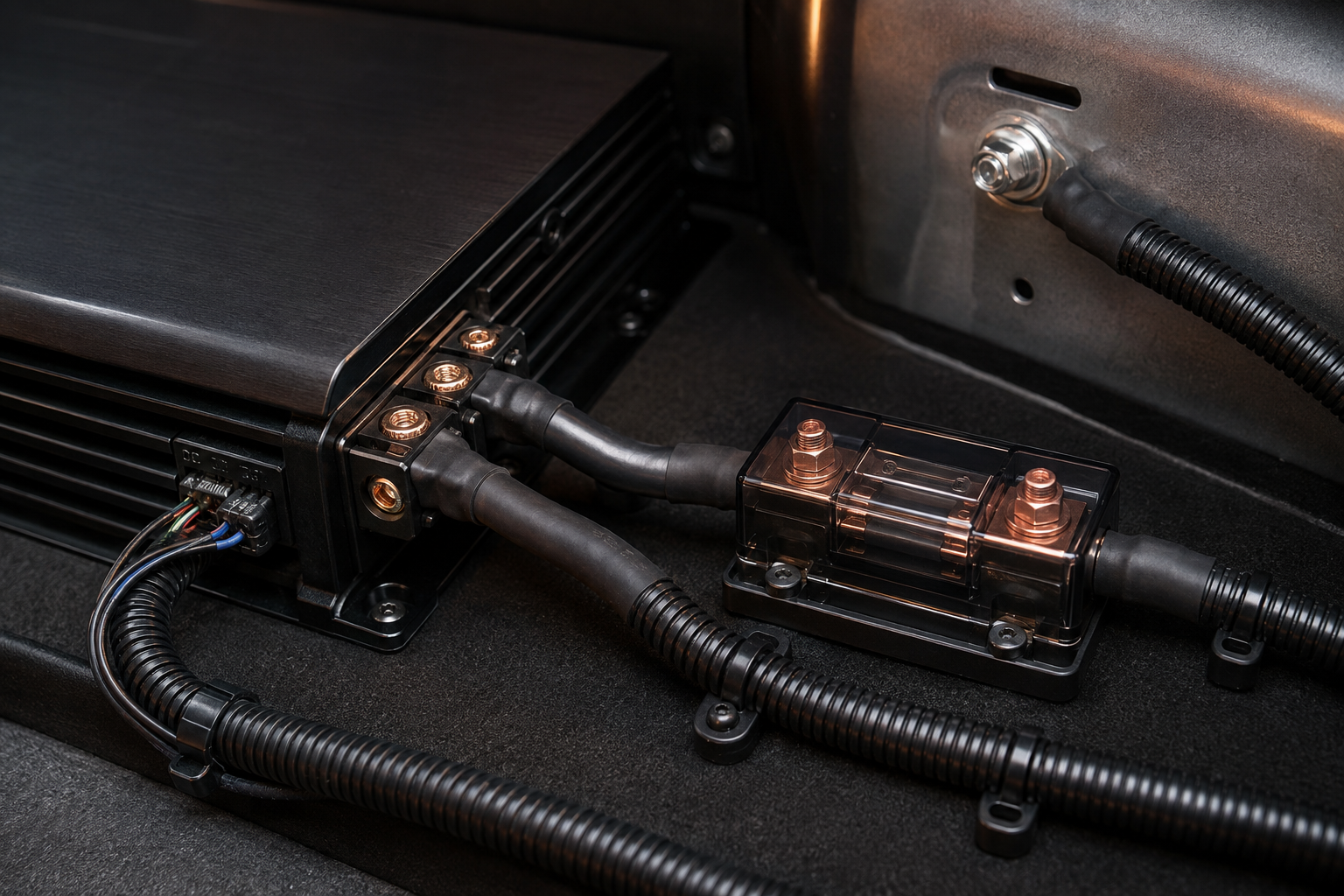
1. Start with the amplifier manual
Record the amplifier's minimum speaker impedance, recommended power and ground cable size, required fuse rating, and remote turn-on method. RMS output—not a peak or MAX number—is the useful power reference.
Do not choose a fuse only from amplifier wattage. The source fuse protects the power cable, while onboard or manufacturer-specified protection addresses the amplifier. Follow the manual and the cable manufacturer's ampacity guidance.
2. Route and protect the positive cable
- Use oxygen-free copper cable of the size required for the total current and cable length.
- Install source overcurrent protection close to the battery, using the maximum distance specified by the fuse holder, cable, amplifier, or vehicle instructions.
- Pass through metal only with a proper grommet or bulkhead fitting and secure the cable away from pedals, steering parts, heat, sharp edges, and seat tracks.
- Fuse every reduction in cable size unless the downstream protection and installation method already provide compliant protection.
3. Build a low-resistance ground
- Keep the ground cable short and at least the same conductor size as the positive feed unless the manual specifies otherwise.
- Use a solid chassis point approved for grounding; remove paint only where the terminal contacts metal, then protect the finished connection from corrosion.
- Use a properly crimped ring terminal, locking hardware, and strain relief. Do not rely on a loose screw, thin sheet-metal edge, or an unknown seat-belt mounting point.
- Measure voltage drop under load instead of assuming a connection is good because continuity beeps.
4. Finish signal and speaker wiring
- Route low-level signal cable away from long parallel runs beside high-current wiring when practical.
- Confirm speaker polarity and the final load seen by every amplifier channel.
- Set crossovers before high-output testing and leave bass boost off during initial setup.
- Reconnect the battery only after checking that positive and ground conductors cannot touch and every connection is insulated and secured.